Thoughts on photo printers and the Epson EcoTanks
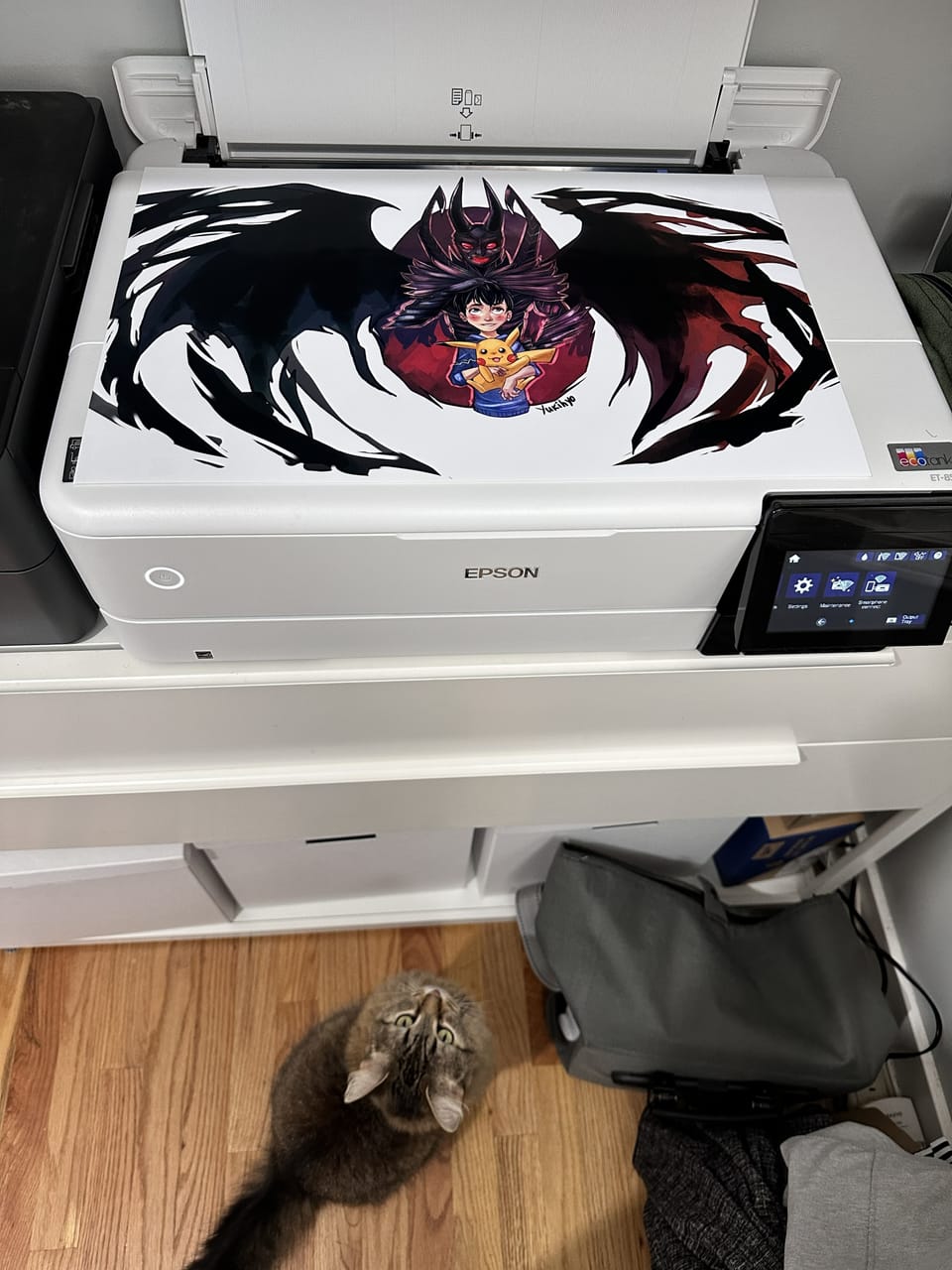
For the most part tech products don’t require much maintenance. Your smartphone doesn’t need oil changes and runs for weeks or months without ever needing to restart. Same with your headphones, keyboard, and/or TV. This is a nice thing; who wants to pay money to add more babysitting work; isn’t that what children and pets are for?
Printers, burdened with the physical realities of paper media and loaded with plethora of consumable parts, stand rather lonely and forgotten among sleeker and more sparkly devices.
They often spend most of their life sitting around and on the occasion a task is required of them, it may throw warnings about low ink or toner, and/or some sort of connection error or jam. To make things worse, printer companies have adopted the razor blade cost structure to cheaply sell or even give away the printer and make the money back by setting ghastly prices for the ink refills and extended warranties. As third parties stepped up to fill the market gap of cheaper alternatives, the printer companies have responded by releasing “updates” to differentiate between “genuine” and “non-genuine” and look for ways to cripple the printer if it detects such a part installed.
While it’s perfectly understandable that a company would want to protect its profits, it’s not a good look when the “genuine” product is one of the most expensive liquids in the world and cannot be differentiated from alternatives that are 10x cheaper. This isn’t innovative nor consumer-friendly and leads to product atrophy. It’s hard to say which came first but it clearly goes hand in hand with the fact that printers are not at the forefront of innovation nor are they raking in the cash companies would like to see before investing more into printer R&D.
Anyway, three paragraphs in and I haven’t even talked about the namesake of the article. Well, this is all to set the stage for why I think the Epson EcoTank ET-8550 is interesting enough to warrant all of this. Remember everything I said earlier about jams and low ink? This unfortunately is further exaggerated with photo printers as they deal with more types of ink and paper. The inkjets are capable of much more fine detail, but have to be exercised often or they start clogging and streaking. Taking all of this into account: the large physical size, high initial and running costs, and temperamental operation, the question becomes why bother?
To be honest a big part of this is just that many people don’t need to print much and when they do the office printer works just fine (the fantastic comedian Sheng Wang has a great bit on printing at work). If you fall into that bucket (I certainly do), then let’s for one second keep in mind that photo printers can deliver much higher fidelity than a printer focused on document printing, where an occasional diagram or stock photo is handled adequately. So it’s become a matter of would you want to print more pictures.
After owning and using a variety of photo printers I have come to really enjoy the process of manifesting the pictures on my screens to a physical form and I believe that there is still an appetite for that joy. Fujifilm’s Instax line has been rising in popularity as it delivers on the photo printing in a nostalgic and portable package that is low maintenance and inexpensive to get started with. If that sounds attractive, then check out it out. I own a Link and enjoy sharing prints with friends and family in the moment.
But say one wants to print bigger, with more detail; something more like that nice poster at a convention or the album from a photo session, then it’s a question of how often one would like to make prints. If it’s a one off or just a few times a year thing, I’d say go with an online photo lab. They do great work and try to make it easy for anyone to make prints on a variety of media. It’s a big upgrade from Walgreens and quite reasonable in price without having to think too much aside from which photo, on what kind of material, and how many copies.
Where getting a dedicated printer comes in is if you’re interested in gaining full control over the entire process. You will be able to get the results without waiting for turnaround time + delivery from another party. Of course, the tradeoff for this is having to own the maintenance and supply, but the reduced friction makes everything more engaging. Being able to experiment with different papers and settings creates room for creative expression and seeing what materials and finishes best complements your work.
Okay, let’s actually talk about the Epson EcoTanks now. As mentioned earlier, if printers have these three pillars to clear; that being size, high costs, and temperamental operation; the Epson EcoTank line manages to take a solid 1.5 off of these. Let’s tally them up:
- SIZE
Printers have to be at least as big as the paper it’s printing, so if the needs are bigger, so must the printer. No win here. The ET-8500 prints up to 11”, the ET-8550 prints up to 13”. - HIGH COST
With the initial cost- $600/700 MSRP (ET-8500/ET-8500) this definitely isn’t a win. However, running costs are a significant portion of total cost of ownership and for the EcoTanks this is 5-10x cheaper than the competition. Due to design technologies and ink choices, the EcoTanks use much less ink, and cheaper types of ink. - TEMPERAMENTAL OPERATION
Hand in hand with #2, the printer’s design reduces maintenance around ink clogging. Typically inkjets need to be run once a week, and the EcoTanks don’t dry out as fast (a few weeks).
If anything I said sounded interesting to you, add one of these to your cart and give it a run. Forget the Epson P700 or the Canon Pixma Pro-300 or the PROGRAFs. Those are for professionals who have a business use case to make up for the extra hassles and costs. If you are a pro or aspiring pro, I am flattered you visited. Kindly check out some of additional reading linked below.
Too much text?
I want to print consumable text based documents like shipping labels, boarding passes, and the images are usually diagram or logos
Brother B&W Laser
I want to print photos, but keep it cheap and easy
I want to send pictures from my phone and share with friends on the go:
Fujifilm Instax or Canon Selphy
I want to print nice big photos and/or make bulk orders once in a while (Christmas cards)
Online photo lab
I want to experiment with different types of print sizes, paper types
I run an art/photography business and want to sell prints
I value keeping my photos in house and not dealing with a turnaround time
Epson EcoTank ET-8500/8550
Printers are for old people and a different time
Perhaps, though the same could be said for vinyl yet many have re-discovered the physical medium
Further reading on the topic:
What’s next for me:
- Delving more into papers (Red River)
- Buying more photo frames to hang the prints up

Comments ()